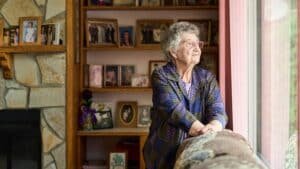
Bette Davis famously quipped that “Old age ain’t for sissies,” in a sly reference that age is fraught with difficulties and obstacles. But current research questions that warning. It turns out that the ages of 64- 84 may in fact be some of the happiest years we experience – the happiest time, in fact, after childhood.
And no, not because we stumble into the later years doddering, dim, and unaware. But rather because of the insights, wisdom, and maturity we’ve gained by facing the challenges and pitfalls we’ve encountered through life.
Unfettered Happiness
“Over the course of a lifetime, happiness tends to start out high early in adulthood and decline in middle age, only to rise later in life” according to Scientific American. Happiness, some believe, follows a U-shaped curve. This was found to be true in 14 different countries, and even among nonhuman apes!
Predictably, happiness declines in teenage years under social pressures, body changes, and emotional swings, and continues in mid-life under the burdens of family, career, economic stress, and social expectations.
By our later years though, we’re less driven by striving for status and concern with what others think. We have usually come to a greater reckoning of what’s meaningful and important to us personally – caring for our loved ones, tending relationships, and giving back. At this time self-development through enriching life-experiences gains importance. Now living our dreams becomes a priority (or guilty pleasure!) after decades of doing for others.
When Happiness Rises
Research from the 2024 World Happiness Report’s Key Stats for Older Adults confirms what many of us intuitively feel: happiness does rise in later life. In the Third Stage of life, or thereabouts, we’ve gained some emotional mastery giving us a more grounded perspective on what actually matters and how best to invest the time we have left.
As we age, we become more aware of the finite nature of our earthly time and look more closely at how to manage it wisely for optimum return. One of the attitudes happiness researchers have found is that people’s feelings about life shift after middle age. We become better at accepting what is, and that can minimize old regrets and disappointments about troubling events that occurred in our earlier years.
We become more pragmatic and develop a greater sense of freedom as we let go of the past. And we eschew drama in favor of depth. We’re more interested in cultivating and deepening relationships, as well as participating in activities that offer the nourishment and soul satisfaction we require to live our best life today.
There Are Exceptions
Of course, these findings don’t hold true for everyone. Poor chronic health, financial instability, and loneliness make the later years difficult and unhappy for many. This is especially true in poorer countries but in the west, for those who enjoy relatively good health and have a strong social network, the happiness factor seems to be reliable.
Once free of many obligations, our focus returns to the interests that may have been shelved in the busy family and career years. What I’m hearing increasingly from women in my classes is the profound desire to find meaningful purpose for their days. To grow and develop their capacities and talents; to uncover gifts that have lain fallow and to resurrect old dreams; to follow their hearts rather than acquiescing to the expectations of others.
Other meaningful endeavors include making a contribution that helps our ailing world and struggling society and connecting with other likeminded women in close, supportive community. Perhaps you, too, feel a call to engage life more purposefully and make a difference.
Stepping Up
The desire to give back is, I believe, hardwired in us. Especially as caretakers, women naturally want to leave the world a better place for having passed through. This is part of the circle of life. Studies unanimously concur that giving back in our later years improves mental health and physical vitality. CoGenerate.org calls this the ‘second act’ when older adults step into civic leadership, community care, and spiritual guidance.
Volunteering at local libraries, food banks, kitchens, and shelters, or in schools are ways to help. Sharing your wisdom with younger family members, mentoring, and listening deeply can also be powerfully helpful. These acts also ripple outwards into the community offering continuing care and kindness.
Who Are You Today?
Often, to understand and develop deeper capacities, it can be useful to look at the archetypes you currently embody – caretaker is common for women but can seem outworn in our later years. Sure, we continue helping but now we may feel bored or restricted in the role, believing, quite accurately, that there must be more. This is when we long for a ‘refresh’, a brighter, even bolder sense of self. Here’s where it pays to watch for the signals and prompts that a new internal voice or ideal may be demanding your attention.
Watch for the archetypes that wish to emerge. After all, they are here to assist us. At different seasons of life different archetypes become available, but we may miss the cues. What worked at age 35 is probably not the most fulfilling archetype in the 60s and beyond.
Feelings of frustration, as though you’re not understanding something important, or a sense that there’s more to you but you’re just not sure what that is, could be indicators that you are ignoring developing an aspect of self that needs your attention and cultivation. By embracing a sense of curiosity and openness you may encourage the awakening of deeper richness and potential within.
Archetypes are messengers of the soul, bringing the lessons and opportunities for growth that are most appropriate now. By heeding the soul‘s invitation to expand not only does your own life improve, often in surprising and unexpected ways, but you are then more capable of becoming a resource to those you love.
What Archetype Speaks to Your Current Season?
Is it Sophia who embodies wisdom and is concerned with the deeper, more mystical and spiritual realms? She is one who often comes to the forefront in our later years.
Or perhaps the Crone, sometimes called the Elder Priestess? She, too, is known for her life wisdom and is a symbol of transformation because she has navigated the highs and lows of life.
Maybe it’s the Sage who has wonderful gifts of maturity and experience to share, or the Queen who leads with authority, intelligence, and kindness? Each of the many archetypes (too many to list here) offers powerful gifts to be explored and shared; they may be gifts of wisdom, creativity, purpose through contribution, or spiritual expression.
The gifts they bring offer blessings to all recipients but are most powerfully transformative to the woman who brings them to life. Who wishes to be awakened within you and how might you activate Her? Make no mistake, she may be just what you need to bring greater joy and happiness into your life!
Let’s Have a Conversation:
If you compare your happiness level today with how you felt in your 30s, and then 50s, do you think you are happier? What factors contribute to your happiness level?