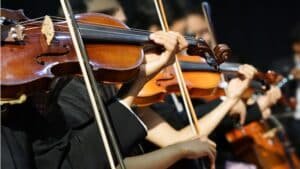
Recently, the young actor Timothee Chalamet created a stir when he stated that “no one cares about ballet and opera.” Although the backlash was swift and strong, there is no doubt that classical art forms are struggling in the modern world. The audiences are aging out, ticket sales and funding are dwindling, and venerable classical institutions need to find links to popular culture to stay relevant.
I was raised in a household which had only one or two 78 rpm recordings of the opera singer Mario Lanza. Although the background soundtrack of my childhood was local and world news on the radio and television, I am grateful to my parents for giving me ballet lessons, and to some very significant early music education experiences. Along with waning ticket sales, music education funds today are on a similar, tragic trajectory.
Music Education Back “in the Day”
Back in the late 1950s and early 1960s, even in my urban public school, all children were given little metal melody flutes and a simple songbook, which were used weekly in the regular elementary classroom. By 5th grade, children were offered music lessons free of charge for the major instruments, and an opportunity to play in the school orchestra or band. I distinctly remember getting a piece of violin music by Vivaldi, entitled Violinkonzert in A Moll (Violin Concerto in A Minor). What the heck was A Moll, my 10-year-old brain wondered?
Advancing to Junior High in the School District of Philadelphia, we had music class three times every week, and we were treated to young artist performances of Julliard Conservatory students and Philadelphia Orchestra members. Still taking violin lessons, I remember playing an abbreviated version of the finale to a Rachmaninoff piano concerto in the student orchestra. I continued my music education in high school by signing up for the chorus just to earn service points, but I was thrilled to sing Handel’s Hallelujah Chorus at Christmas time.
The Beginning of a Classical Recording Collection
When I started college, my interest in classical music swelled. I was taking ballet classes twice each week, and I relished the euphoric feeling of the beloved ballet music composers such as Chopin, Schubert and Tchaikovsky coursing through my body as I danced. I vowed to begin creating a classical music recording collection, which I did in the era of 33 1/3 rpm long playing records. When I heard a piece I loved in ballet class, I bought a recording and it expanded my knowledge of composers exponentially. At this time, I became a regular listener of the Philadelphia classical music radio station. I applied the same collecting principles to favorite pieces I heard on the radio.
Through the years, my loyalty to classical music remained constant. Only the recording collection took different forms. Of course, there were major recording format shifts: cassette tapes, CDs, and now digital music. Just as there were Book of the Month clubs, there was a classical music club, The Musical Heritage Society, which sent monthly catalogs, and the desired recordings could be ordered by mail. Shifting formats as they arose, eventually, I amassed a beautiful collection of classical CDs.
What Is the Value of Classical Music?
Oddly enough, neurologists have found that music occupies a larger area of the brain than language. The provocative emotions, rhythms, melodies and reward centers are all located in disparate regions of the brain, unlike other brain processes which are more regional. This might explain why a response to music is more lasting than language in those with neurological challenges, such as Parkinson’s Disease, Stroke, and Alzheimer’s.
My love affair with classical music illustrates the emotional depth and cathartic nature of this music. Physically, classical music has been known to lower stress, boost focus and enhance memory and concentration. To me, its chief virtue is the palpable connection to emotions, memories and the subconscious, nothing less than a transcendental experience.
Classical Music in Retirement
My retirement background soundtrack comes courtesy of two platforms: WRTI, the current classical music station in Philadelphia connected to Temple University and the Apple Classical Music App, which I play through a Bose wireless speaker. WRTI is the current iteration of the station I began listening to in my college years. Happily, it is available all over the world online.
WRTI has a delightful rotation of hosts, uniquely qualified to educate and tempt the listener to experiment with new and venerable purveyors of this art form. I’m still happily learning and exploring new genres and artists under the hosts’ guidance. This platform is a 24-hour classical (and separate jazz) stream. New recordings are “meticulously selected,” and the “time-honored composers” have a great presence.
The Apple Classical Music App
The app has helpful features such as a sleep timer and alarm clock, the ability to pause, rewind and fast forward, and is available for free on iTunes and Google Play.
Without exaggeration, this app has changed my life. Before the internet, one would have budgeting and logistical limitations related to purchasing classical CDs. Exposure to new artists and works, and finances would be the largest limitation in acquiring recordings.
The Apple Classical App has 5 million tracks, and it is available in three price tiers: the individual cost is $10.99/month, the student rate is $5.99/month for four years, and the family rate for 6 members is $16.99/month, literally less than the price for one new CD. It is not a stand-alone product, but is part of the regular Apple Music App. For one monthly fee, the subscriber has access to both immense archives of music. To get an overview, this techhive.com post and this YouTube video might be helpful.
This app was acquired from Primephonic in 2021. This company had solved the complex issue of how a listener could search the vast cannon of classical music by work, composer, genre, orchestra etc. Apple refined the process and gave it its own aesthetic and technical stamp.
Currently, the various rows of the home page offer the listener a selection of new releases, recently played selections, updated playlists (made and curated by Apple Classical), stations (single focus playlists such as piano or cinematic classical), listening guides, albums we love, and more!
The search feature allows the listener to browse by composer, work, conductor, catalog number, or instrument. All available recordings are listed with a short description and the most popular recordings highlighted. Playlists, albums, tracks, artists, recordings, works and composers are easily stored in a personal library.
Included in the app is a nine-part series, The Story of Classical, which provides the novice and experienced listener with the history and context for different eras and an accompanying selection of recordings. The Track by Track feature allows artists such as Lang Lang or Hilary Hahn to comment on each track of their popular albums.
I have a regular routine of listening to WRTI in the morning and in the evening when I make dinner. At other times, the Apple Music App accompanies me in the car, at home, and through my day. With its myriad offerings, I am constantly learning about new artists, works, and genres which would never have been available previously.
I am indebted to Apple for my burgeoning love affairs with the pianist Vikingur Olafsson, Czech composer Antonin Dvorak, minimalist Max Richter, the Danish String Quartet, and Chopin’s Irish predecessor John Field. I hope my husband isn’t jealous!
Let’s Talk:
How is music part of your everyday life? What formats work for you? Have you ever had an interest in classical music?