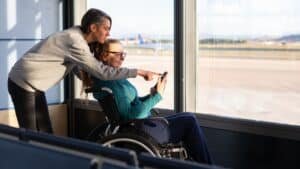
Years ago, I flew to Baltimore with my broken leg in a cast, in a wheelchair with the leg extended. My family stood guard around me but an incursion at the gate left me reeling. A woman came barreling up to the agent, in a panic, and smashed my cast with her bag. I saw stars.
In the last few years, I’ve damaged my shoulder and my decades of living with rheumatoid arthritis added to the injury. Simply put – my shoulder tears are partly a result of lifting and dragging heavy baggage through airports. Through trial and error, because I fly often, I’ve developed strategies to keep me safer when traveling by plane. This advice applies to other forms of transport as well.
Pack Efficiently
I’ve learned that I don’t need as many clothes choices as I once brought on a trip. Wearing the same outfit on multiple days lessens the load in my suitcase and strangers don’t notice the repeats. Many travel experts recommend specific types of clothing that mix and match and are appropriate for a variety of climates, leaving baggage lighter and easy to manage.
This YouTube travel couple provides links to products they test and share with their viewers. I wear one of their recommendations, a smart wool top, when traveling because of its versatility through different types of weather.
Black Vionic sneakers help my stability by providing sure footing. They also work with dark slacks as an outfit that goes from daytime conference to dinner at a nice restaurant. Two or three nice blouses, like the ones from NYDJ, take up little room in a suitcase and don’t need ironing on arrival. I roll most of my clothing and use packing cubes to keep smaller items together. And, finally, I make sure my suitcases have well-oiled wheels and are easy to steer.
Reserve a Seat
I prefer an aisle seat but, since I’ve injured my right shoulder, I pick a seat against the window, protecting that arm from others. If traveling with my husband, he goes on my injured side. Choosing your seat is an upgrade on most airlines, though some, like Southwest, do offer seat choice for free to a limited number of passengers who book early enough.
Contact the airline via chat or phone in advance if your disability makes it difficult to sit in the middle seat and see if they can work out a better location for you. It’s not a guarantee, but it’s been my experience they are willing to try. As airlines institute more fees for seat location, look into programs that offer you upgrades for miles or points and consider that extra charge for a reserved seat a gift to your body, if it’s your only choice.
Check Your Luggage
My baggage is not your baggage. If you have difficulties lifting into the overhead for any reason, consider checking your bag. For me, it’s worth $40 to save my shoulder from more stress and strain. In addition, some airline credit cards grant you one free checked bag, else you can often gate check at no upcharge.
The extra time you’ll spend at baggage claim is a small sacrifice when compared to added injury caused by lifting or dragging your heavier suitcase through large airports. If you cannot manage these strategies, then ask the general question when boarding, “Can someone help me lift this?” An able-bodied soul will come to your rescue, and no one will feel pressured to cater to you.
Don’t assume that six-foot tall man is able to toss your bag in the compartment. He may have a torn deltoid muscle or a swollen disc in his neck. If you do have to lift your own bag, take time to set your stance and use good body mechanics. And remember, the flight crew have to preserve their joints too and are not obligated to help you.
Admit Your Issues
Wear your sling, bring your cane, board early. My physical therapist recommends I travel with my sling in place, making it obvious to other passengers to steer clear. An inadvertent bump will send shock waves through my arm. I board the plane with the disabled group after checking with the gate agent.
If my husband is with me, he stows my carry-on. I use a super-compact roller bag for my computer and kindle that slides under the seat. My typical purse is a cross-body bag with RFID for security that tucks into my carry-on. I wear my cross-body through the airport to make it easier to access my wallet and phone and keep my belongings safe when in restaurants or restrooms.
Bring a Pillow
I travel with a small pillow that I use to bolster my arm. Depending on your personal issue, the pillow can be used on the plane, at the hotel, or in your rental car. I’ve found squishy pillows useful to wrap under sore joints. Bring a pillowcase to keep the pillow itself clean. Most travel pillows can be thrown in the laundry when you get home.
Wear Appropriate Clothing and Create Smart Habits
Invest in travel clothes that make it easy to navigate the aisles and restrooms. Wear what you’re comfortable in and carry a lightweight scarf to use when the fans are blasting on the plane. I wear an N-95 mask when boarding and deplaning because of my autoimmune disease. If 150 people are going to pass by me in the aisle, sneezing or coughing over my head, I want to avoid their germs.
Many people wash their seat arms, tray table, and seatbelt with an antibacterial wipe when flying. In my estimation, it can’t hurt.
Don’t Rush, Don’t Panic, Slow Down
We’ve all seen passengers who arrive at the airport too late, running to their gate, dodging the crowds, and making it dangerous for all of us. Try to get to the airport early enough to avoid a mad dash. If you travel often, invest in security options like TSA precheck and Clear Plus which cut down your time in line.
Check the TSA app to see history-based wait times in airports. An added benefit to the app is that you can inquire about appropriate items to carry on the plane. Pay attention to what’s restricted so as not to delay yourself and those behind you when going through TSA checkpoints. Most importantly, plan ahead. Order your taxi or ride share early in case of extra traffic or an accident.
Check travel time on the road to the airport with Waze or another map app. Read the signs and electronic boards in the airport carefully once you arrive. I’ve sat at an empty gate when my plane had a last minute gate change, leaving me to hustle once I discovered the problem. If you get confused, ask airline or TSA employees for help.
Please don’t be that panicked traveler who smashes their bag into a broken leg.
Let’s Have a Conversation:
What are your tips for keeping healthy and avoiding injury when traveling by air? Do you have favorite products that make it easier for you navigate airports?