My mom never stopped asking me when I was going to have my long hair cut short. Even at 96 years old, she felt compelled to warn me that long hair on women of a certain age looked “inappropriate,” her word for attention-seeking.
With an adorable, curly pomp that got a “wash and set” every Friday, my mom was understandably a product of a generation where women, once married and maternal, were expected to do the sensible thing with their hair.
Old cultural norms told us that long hair belonged to the young, the carefree and the delightfully flirtatious. Once you had children, wanted to be taken seriously in your career, or passed some invisible expiration date on desirability, a short crop or a chin-grazing bob was just another rite of passage.
And yet, here we are in 2026, watching women over 60 go to great lengths to do exactly the opposite.
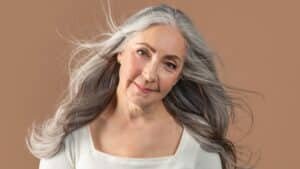
Scroll social media, flip through fashion coverage, or simply pay attention in the real world, and you’ll see it everywhere: silver hair worn long and loose, glossy ponytails swinging with confidence or peeking out from the backs of baseball caps, soft waves framing faces rich with experience. Later-life women are no longer quietly editing themselves out of the style conversation. They’re embracing every opportunity to dress their authentic selves, and long hair has become one of its most visible signatures.
Style-Makers Over 60 Prove Long Hair Has No Age Limit
Celebrities and style-makers have helped normalize this shift. Actress Demi Moore has made long, dark hair part of her enduring visual identity, well into her 60s. She even locked in an endorsement contract as Global Brand Ambassador for the Kérastase line of hair care – a deal usually reserved for 20-year-old stars.
Academy Award winner Michelle Yeoh, also in her 60s and more powerful than ever, often wears her hair long and flowing, pairing elegance with authority on red carpets around the world. Trinny Woodall, a popular midlife style rule-breaker, regularly shows up online with long, undone hair that reinforces her message: wear what works for you. And actress, singer and songwriter Rita Wilson continues to favor long, feminine styles that feel relaxed, confident, and unmistakably modern.
What’s striking is that none of this feels like clinging to youth. It feels like living authentically and claiming visibility.
For decades, women were subtly told that long hair signaled a desire for male attention, or worse, an unwillingness to look or grow “old.” Thank goodness today’s later-life women are outliving those stereotypes. Many are single, dating again, or simply enjoying a renewed relationship with their own concept of what it means to look and feel beautiful. Long hair, for some, seems playful, while for others it feels powerful. For many, it’s just who they are.
The Beauty Industry Responds to Women Over 60 Embracing Long Hair
The beauty industry is fully on board with the later-life, long hair movement. According to industry analysts, the global hair care market has ballooned into an annual $80+ billion category, with particularly strong growth in premium products, serums, masks, and scalp treatments. These are exactly the kinds of tools that support longer, healthier hair at every age.
Hair color, too, has become more nuanced and sophisticated, with gray-blending techniques, dimensional color, and gentler formulations making it easier than ever to maintain long, lush locks without sacrificing hair health. Long hair is no longer reserved for the young or genetically lucky. It’s accessible because it’s supported by better technology, smarter formulations, and a broader understanding that great hair doesn’t have an age limit.
Recently, I had this conversation with my hair stylist, John Vega of Salon Del Mar in Santa Fe, New Mexico. John began cutting hair in the 1980s and says he has seen every trend from shaved heads to Cher hair. He notes that well-groomed, below-the-shoulders hair has become entirely acceptable for women in their later years.
“I wouldn’t say that the women I see are focused on sex appeal,” Vega explains. “It’s more about feeling independent and being able to look how they want. Women see older celebrities with long hair looking great and really owning their identity. They don’t feel like they have to give that up simply because of the age on their driver’s license.”
Growing Long Hair After Chemotherapy: Reclaiming Femininity
For some women, growing hair long later in life carries even deeper meaning. After chemotherapy and cancer treatment, hair loss can feel like a public stripping away of femininity and control. Growing hair long again becomes an act of rebellion and reclamation and a visible declaration of survival. For these cancer warriors, it’s not about vanity. It’s about agency and choosing to look and feel “womanly” after a period of devastating trauma.
Reinventing Yourself After 60: Freedom, Visibility and Choice
And then there’s freedom. Many women in their 60s and beyond are no longer living by anyone else’s rules. Children leave the house, careers shift, partnerships change, and body image evolves. What’s left is a wide-open space ready to be filled with something new – or perhaps the return of something from long ago.
What’s most powerful is how unforced this movement feels. No manifesto. No trend forecast required. Just women choosing what feels expressive, authentic, and joyful for themselves.
Going to great lengths, it turns out, has very little to do with hair. It’s about the refusal to believe there’s an expiration date on anything that makes you feel good.
Let’s Have a Conversation:
How do you wear your hair? What have you been told about keeping your hair long?