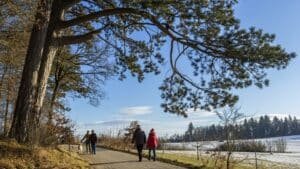
The German Sonntagsspaziergang is a centuries-old practice of walking on Sunday, which remains a protected Ruhetag (day of rest) throughout Germany. On this day, entire populations take to the woods, riverbanks, and neighborhood paths in what resembles a slow-motion pilgrimage. Families walk three abreast. Elderly couples proceed arm-in-arm. Teenagers dawdle behind their parents, and the whole procession often culminates in the anticipated reward of Kaffee und Kuchen (coffee and cake) at a local café or kitchen table.
The Sonntagsspaziergang treats walking as a form of attention, a way of becoming literate in the language of your own landscape.
The practice is naturally accessible. Local parks suffice. Converted rail trails work perfectly. Ordinary neighborhood streets become adequate stages for this weekly performance. The infrastructure already exists.
This mode of observation has deep roots in German and broader European traditions of contemplative walking and natural philosophy. John Burroughs, the 19th-century American nature writer, practiced a closely related form at his retreat, Slabsides. By walking the same three-mile loop repeatedly, he trained himself to notice what he called “small truths”: the specific week maples turn scarlet, the day red-winged blackbirds return, the gradual surrender of a wooden fence to entropy. Repetition breeds intimacy.
Walking through a landscape at human pace – slow enough to hear footsteps, fast enough to cover ground – transforms environment into relationship. The German concept of Waldeinsamkeit captures this: the particular solitude found only in forests, a feeling both alone and accompanied. The Sonntagsspaziergang cultivates this intimacy deliberately. “The woods” becomes your woods. “The park” becomes a weekly companion whose moods and seasons you learn to read.
A Sunday in Bonn
In Bonn, for example, the Sunday stroll follows the Rhine’s pathways. Families walk the Rheinaue, the sprawling park created from former floodplains, where wide paths wind between lakes and meadows. Others take the promenade along the riverbank itself, watching barges move slowly upstream while cyclists pass and joggers navigate around the steady stream of walkers. The path continues south toward Bad Godesberg or north toward the Siebengebirge hills visible across the water.
The rhythm is unhurried. People stop to watch swans near the shore or to let children investigate interesting stones. Benches fill with readers and observers. The destination matters less than the duration – the commitment to spending the afternoon outside, moving through familiar territory at walking pace. Many end at an Ausflugslokal along the route or return home for coffee and cake.
Adapting the Practice: Elements of a Sunday Walk
Germans don’t follow a manual for their Sunday strolls – the tradition is passed down organically, practiced intuitively. For others looking to adapt the spirit of the Sonntagsspaziergang, certain elements emerge from observing the practice:
Choose familiar ground. The same loop through a local park, the neighborhood circuit, the path you could walk in the dark. Repetition allows you to notice change.
Let your senses anchor you. The wind in bare branches, a cardinal’s call, distant traffic. These sounds pull attention outward into the present landscape.
Pause deliberately. Sixty seconds observing moss on bark, the joinery of a stone wall, the exact shade of a budding branch. The slower pace reveals what rushing obscures.
Leave your phone behind or pocketed. The walk is a conversation with immediate surroundings.
End with something small and ritualized. Coffee at the kitchen table. A slice of bread with butter and jam. This simple reward marks the boundary between the walk and the return home, giving the practice its shape.
The Sonntagsspaziergang elevates the ordinary through sustained attention. By protecting Sunday afternoon for observation, practitioners become inhabitants of their geography. The discipline lives in the patience to let the world reveal itself slowly. Walk out the front door and pay attention.
Let’s Have a Conversation:
Do you have a specific Sunday practice in nature? What does it look like? What do you like to observe/listen to/explore?